From emergency response to dignified homes
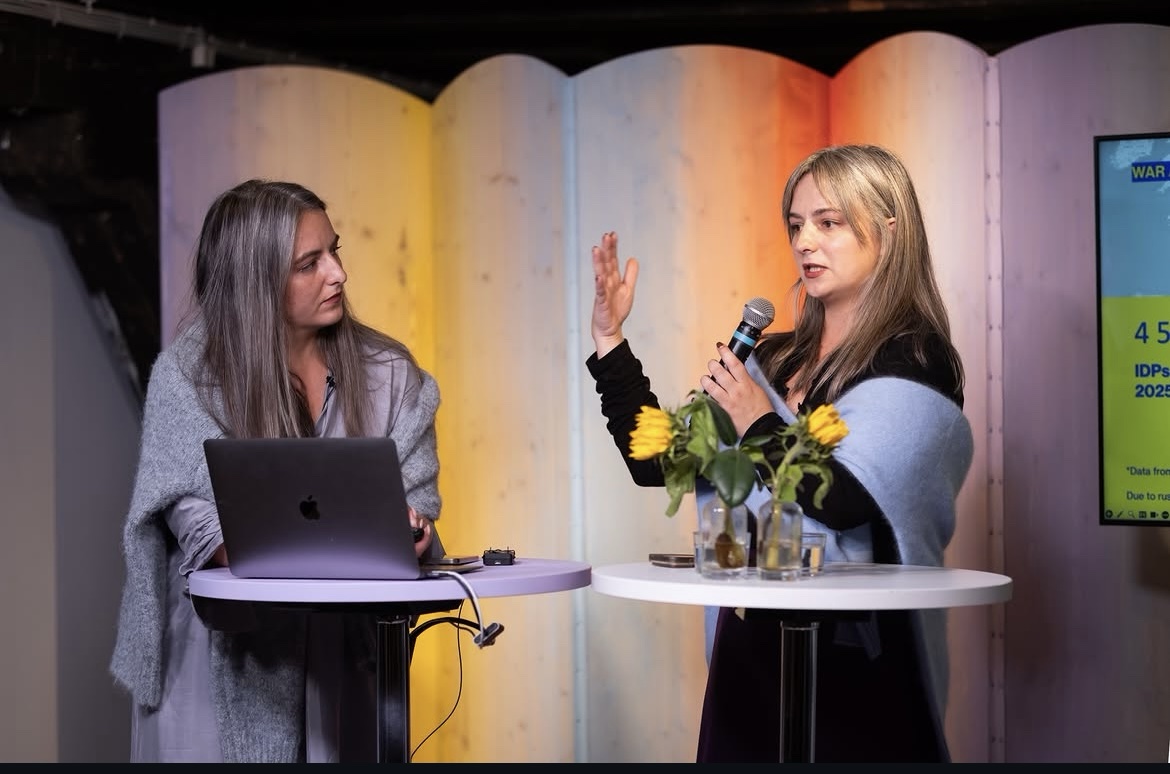
What can architecture do in the middle of a war? For Ukrainian urban laboratory METALAB and housing initiative CO-HATY, the answer has been to turn empty buildings into homes and to make dignity, community and hope part of the rebuilding process.
On Wednesday this week, the sisters and architects Tania and Anna Pashynska, co-founders of METALAB and CO-HATY, shared their experience at Architecture Day at Form/Design Center in Malmö. Under the theme “Proximities”, the event explored how architecture can contribute to democracy, community and the places we share. Their presentation showed what this can mean in practice – in a country where millions of people have been forced from their homes.
METALAB is one of IM’s partner organisations in Ukraine, and IM helps finance its work. Through our partnership, we support METALAB’s efforts to create safe and dignified housing for people displaced by the war, while contributing to longer-term solutions for communities across Ukraine.
From crisis response to rebuilding
When Russia launched its full-scale invasion of Ukraine in February 2022, architects and urbanists from METALAB in Ivano-Frankivsk found themselves facing a completely new reality. Their work was no longer only about cities and buildings. It was about responding to an immediate humanitarian crisis.
Together with members of Urban Curators who had relocated from Kyiv, METALAB launched CO-HATY in March 2022 to create housing for people who had lost their homes. What started as a volunteer response has since grown into a professional organisation working to develop models for long-term, affordable housing in Ukraine.
In the first weeks of the full-scale invasion, METALAB’s work was focused on immediate needs. Volunteers welded anti-tank structures and helped convert buses into ambulances.
But as the war continued, another urgent need became increasingly clear: housing.
The first CO-HATY pilot project mobilised around 200 volunteers and approximately €30,000 to renovate a four-storey, 2,000-square-metre dormitory in just six weeks. Since then, the initiative has grown considerably, with projects transforming buildings into housing for internally displaced people.
The work has also changed the organisation itself. What began as a small architecture bureau and volunteer initiative has developed into a professional operation involving architects, engineers, urbanists and construction specialists. The team now works across the entire process – from finding and acquiring buildings and collaborating with municipalities to fundraising, design and construction management.
More than a roof over your head
For CO-HATY, housing is about much more than providing four walls and a roof.
The projects are designed to create places where people can begin to rebuild their lives. Early projects often involved shared kitchens and other communal facilities. Over time, the model has evolved towards apartments with private kitchenettes and bathrooms, while maintaining spaces that encourage community and connection.
The aim is to create homes that feel like homes – not temporary shelters.
Residents are involved in planning, renovating and managing the spaces, helping to build a sense of ownership and a community where neighbours can support one another. The projects also seek to connect residents with the wider neighbourhood through shared public spaces and opportunities for education and participation.
Turning ideas into action
At the Malmö presentation, METALAB and CO-HATY also demonstrated how concepts such as circularity, sustainability and gender equality can move from words to practical solutions.
Whenever possible, materials from existing buildings are reused. Bricks from demolished walls can, for example, become part of new ones. This reduces waste while making use of resources that are already available.
And in a country where many men are serving on the frontlines, women have played a central role in carrying out the work – from architecture and project management to construction and community development.
This is a form of architecture shaped by the realities of war, rather than separated from them.
Dignity, beauty and the right to normality
Perhaps the most powerful message from the presentation was also the simplest: people affected by war deserve more than survival.
They deserve safety, dignity and beauty.
CO-HATY’s approach is based on the idea that a person who has been forced from their home should not have to live indefinitely in a place that feels temporary or forgotten. Details matter. Light, colour, plants, furniture, private spaces and places to meet other people all contribute to creating a sense of home.
For people who have lost almost everything, these things can be part of rebuilding a sense of normality.
And that, ultimately, is where architecture meets humanitarian work: not only in the physical rebuilding of buildings, but in creating the conditions for people to recover, belong and imagine a future.
Building for the future
The housing crisis created by the war will not disappear when the fighting eventually ends. Many Ukrainians will not be able to return to their homes for a long time, while the need for affordable housing will remain.
CO-HATY is therefore working towards a model for long-term affordable housing that can be adapted and expanded in different parts of Ukraine. The initiative is also participating in working groups connected to Ukraine’s housing reform, seeking to contribute practical experience to the development of future housing policy.
What began as a rapid response to an unprecedented crisis has become something larger: an attempt to rethink what housing can mean in wartime – and how architecture can contribute to rebuilding not only buildings, but communities.
Through METALAB and CO-HATY, architecture becomes more than a profession. It becomes a practical way of restoring dignity, strengthening communities and creating space for a future.
Text: Francis Ramos and Malin Kihlström