“We thought we would be gone for a week or two.”
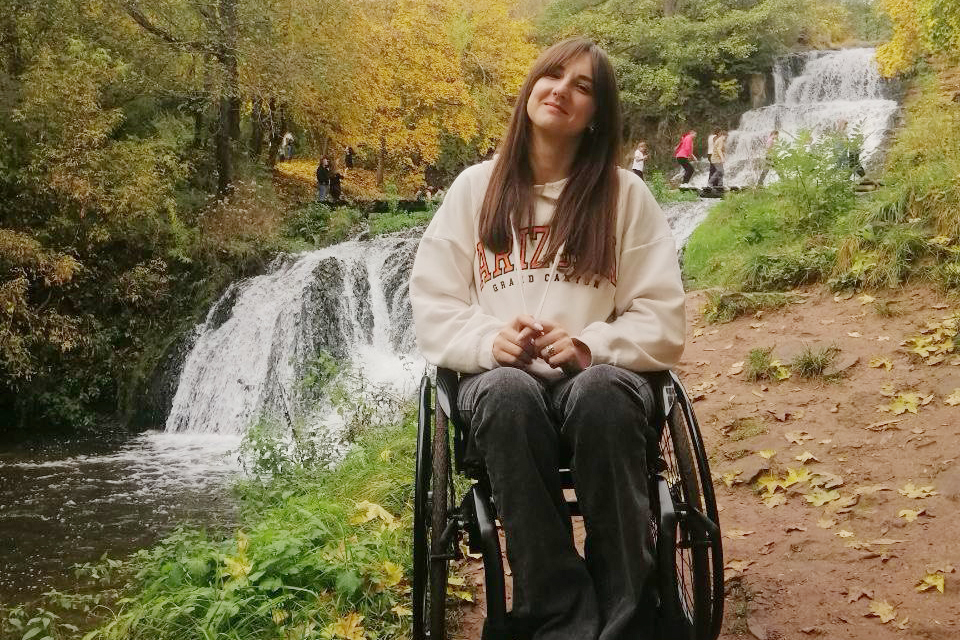
Yuliya Garmash was living in the Izium district of the Kharkiv region when Russia launched its full-scale invasion. Like many others, she hoped until the very last moment that the war would not reach her village – a place with no strategic targets, far from the front line.
But in March 2022, the shelling of Izium intensified. The explosions grew closer, and it became clear that the family was no longer safe.
“We understood that the troops were approaching. Sooner or later, they would come here,” Yuliya recalls.
A displacement with no end date
The decision to leave home was difficult and was not seen as permanent. On 5 April 2022, Yuliya and her family travelled to Chernivtsi, bringing only the essentials: documents, a few belongings, and the family’s animals.
“We thought we would be gone for a week or two and then return.”
A week later, their village was occupied. The occupation lasted for five months. What was meant to be a temporary journey turned into a prolonged displacement.
Staying – despite everything
Yuliya, who has a disability, was offered evacuation abroad several times. But the offers applied only to her – not to the entire family.
“Leaving would have meant being separated. For me, that was impossible. I needed to stay with my family, even if it meant greater risks.”
The decision was not about safety or comfort, but about togetherness.
Life as an internally displaced person
The first months in Chernivtsi were marked by shock and waiting. Yuliya describes the period as hazy – days passed, but life felt suspended. At the same time, she followed news from the Kharkiv region and from friends living under occupation.
“You are physically safe, but mentally you are still back home.”
The uncertainty affected everything, including her work as an English teacher. She questioned whether teaching even mattered in the middle of a war. But when she eventually reconnected with her students, her work became a lifeline.
“It gave me a sense of purpose. That I was still needed.”
Support that makes a difference
In Chernivtsi, Yuliya actively sought support – especially as an internally displaced person with a disability. Through civil society organisations, including IM’s partner organisation Zahyst, she received humanitarian assistance, practical guidance, and contacts.
“When people respond, when someone helps you, life slowly begins to stabilise again.”
At the same time, she encountered significant barriers. Many support programmes were time-limited, and she often fell outside the systems. Having to repeatedly prove her need for assistance took a heavy toll.
“It affects your dignity. As if you have to earn the right to receive help.”
A life of constant uncertainty
Today, Yuliya lives in the Poltava region. She works, studies, and tries to build a new home. But the war continues to shape everyday life: power outages, lack of accessibility, and a future that cannot be planned.
“Everything feels fragile. It’s hard to even think a few steps ahead.”
Her dream is the same as that of millions of other Ukrainians.
“That the war will end. That we will be able to live in peace and plan our lives again.”
Yuliya’s story shows how the war affects people’s lives far beyond the front line—and why support for displaced people, for civil society, and for those who otherwise risk falling through the cracks is essential.
Text: Zahyst
Edited by: Malin Kihlström
Photo: Private
By: Malin Kihlström