When the war came
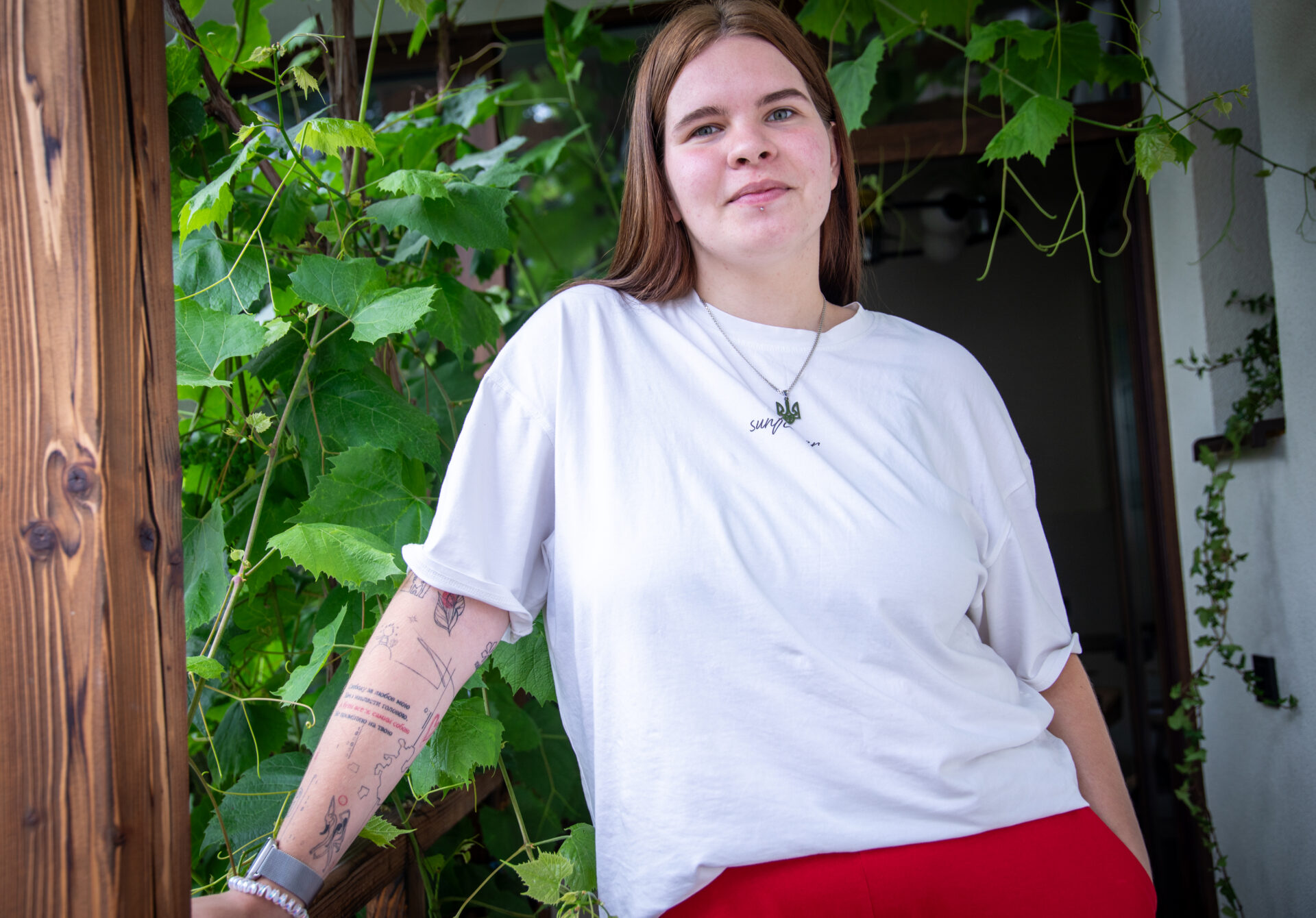
When Russia launched its full-scale invasion of Ukraine, Kateryna Shulakova had already spent much of her life living close to war. But nothing could prepare her for 24 February 2022. In the midst of chaos, displacement and economic uncertainty, the support of IM’s partner organisation STAN became a turning point – and a place where she could regain control over her life.
Kateryna Shulakova was born and raised in Popasna, in the Luhansk region, just a few kilometres from Pervomaisk – a city that has been occupied by Russia since 2014. Popasna quickly became a frontline city, and war became part of everyday life.
“I started my journey as an activist there,” Kateryna says. “We gathered at a centre for extracurricular education, built a community and founded an organisation together.”
When the war truly broke out
When the full-scale invasion began, Kateryna and her colleagues were in Kyiv. They were there to submit a project application, but suddenly everything revolved around survival. Some stayed to help people trying to flee, while others worked to break the information blackout around their home city.
On 24 February, Kateryna took the train back to Popasna.
“I wanted to be with my family. It felt calmer that way.”
She travelled via Kharkiv, where her father picked her up by car. During the curfew, they encountered Russian tanks on the district road.
“When you see tanks without flags and don’t know what’s happening, it’s terrifying.”
At the same time, the reality of war was not entirely new to her.
“I was in Popasna during the occupation in 2014. So the fact of war itself didn’t scare me as much. I was ready to do what was needed to make life a little easier for the people around me.”
Displacement and economic uncertainty
When the family eventually left Popasna, they ended up in Odesa, where they lived for three months. The greatest shock did not come from the shelling – but from the economic reality.
“My family believed that all money should go into real estate. ‘Real estate doesn’t move,’ people say. But it turned out that it does.”
They fled with very limited resources. Kateryna’s parents, who had run a business for more than 20 years, struggled to find work. Crowded living conditions, uncertainty and stress took their toll.
“We were all sitting in a small house, with no idea what to do next. It wasn’t easy.”
A new beginning with STAN
When Kateryna later returned to Kyiv, she felt for the first time that she could take control of her life again. That was when she came into contact with STAN, one of IM’s partner organisations in Ukraine.
She joined the introductory workshop of the Young Diversity Ambassadors programme – and was quickly drawn into the community.
“It felt like entering a space full of inspiring people. We created projects such as Portraits of Luhansk Region, which meant a lot to me.”
For Kateryna, the support was not only about training or workshops.
“The most important thing was the people. The conversations outside the sessions, the sense of belonging, the community.”
Understanding rights – and one’s own power
Through STAN, Kateryna gained new perspectives on her activism.
“Before, I didn’t really think about human rights, even though we were working with young people. I thought that my friends and I represented all youth. The programme helped me understand how diverse the world actually is.”
She describes a shift in mindset – from trying to change herself to fit the circumstances, to wanting to change the circumstances themselves.
“I realised that I can influence what is happening around me. That was a major turning point.”
A community that carries – even in times of war
Today, Kateryna has lived, studied and worked in several countries and cities. But whether she was in Stockholm, Kyiv or Ivano-Frankivsk, STAN remained a constant source of support.
“I knew there was a community that could welcome me and support me. That feeling of care meant everything.”
For Kateryna, the support from STAN became not only a lifeline during the war – but a foundation on which to build her future.
Photo: Erik Törner
Text: STAN, edited by Malin Kihlström
By: Malin Kihlström